Centre for Teaching and Learning of Mathematics
September 25, 2020 2026-08-24 20:57Centre for Teaching and Learning of Mathematics
Centre for Teaching and Learning of Mathematics
The Centre for Teaching-Learning of Mathematics (CTLM) is based in Framingham, Massachusetts, with offices in England and India. It was founded by Professor Mahesh Sharma with a vision to develop and promote efficient, elegant, and effective methods of teaching and learning mathematics, from early childhood through high school and teacher training.
At CTLM, we are committed to bringing the best practices in mathematics teaching—drawn from research, classroom experience, and observations of teachers around the world—into the classroom. We use these teaching techniques in our courses, workshops, webinars, classroom demonstrations, and private tutoring. We have helped thousands of educators, from pre-service teachers to veteran teachers, improve their instruction so that children can develop mastery of mathematical ideas, including concepts, procedures, and skills.
We at CTLM believe that children should develop mastery of mathematical concepts with a clear emphasis on language, concepts, and procedures. Ultimately, these concepts and procedures should become skills, tools, and ideas through their application in various settings—intra-mathematical, interdisciplinary, and extracurricular.
We believe that children can achieve mastery only when lessons are delivered in ways that allow students to experience concepts at six levels of knowing: beginning with the intuitive level of knowing, progressing through the concrete, pictorial, and abstract/symbolic levels, and then applying these ideas in problem-solving to reach the communication level of knowing. This approach is called CPVA/S.
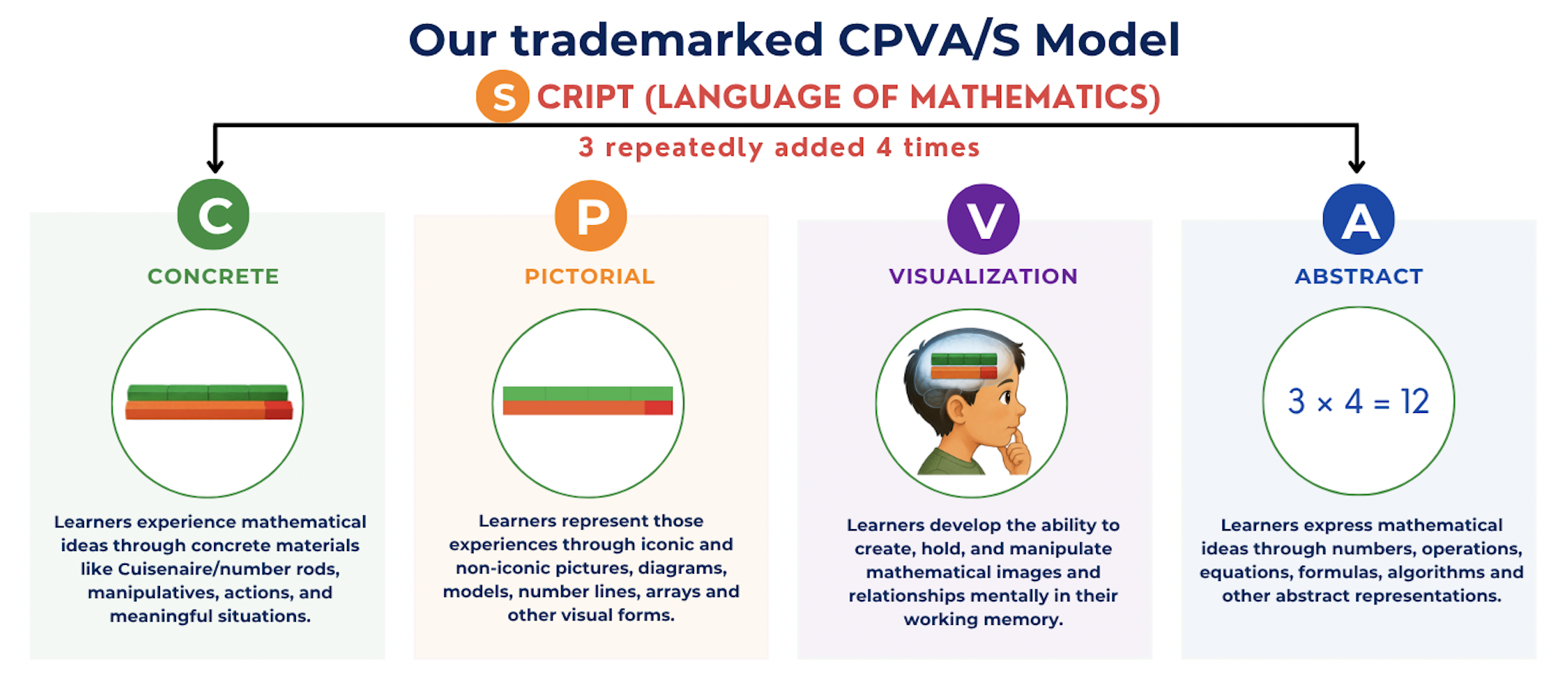
CPVA/S stands for Concrete–Pictorial–Visualization–Abstract/Scripts and represents a coherent progression in the teaching and learning of mathematical concepts.
C – Concrete: The learner experiences and explores a mathematical concept through concrete materials, manipulatives, models, and real-life experiences. These experiences help the child build a strong conceptual foundation and form a concrete conceptual schema.
P – Pictorial: The learner represents the concrete experience through pictures, diagrams, drawings, and other iconic and non-iconic representations. The pictorial level helps the child move beyond physical materials while retaining a meaningful representation of the mathematical concept.
V – Visualization: The learner forms, holds, and manipulates an image of the mathematical concept in the mind’s eye. Visualization serves as the critical bridge between pictorial representation and abstract thinking. With the support of an appropriate script, the child learns to mentally manipulate the image without depending on concrete materials or external pictures.
A – Abstract: The learner expresses and works with the mathematical concept using numbers, symbols, mathematical notation, algorithms, and other abstract representations. Because the abstract representation has developed from meaningful concrete, pictorial, and visualization experiences, the symbols carry conceptual meaning rather than being treated merely as rules to memorize.
S – Scripts: Scripts are linguistic containers of mathematical concepts and procedures. They provide precise, coherent, and connected mathematical language that accompanies the learner through the concrete, pictorial, visualization, and abstract levels. The script binds the different representations of a concept together, enabling the learner to experience them not as isolated stages but as one coherent conceptual whole.
The CPVA/S approach therefore differs from the conventional CPA approach in two important ways: it explicitly recognizes Visualization (V) as a crucial bridge between pictorial and abstract thinking, and it uses Scripts (S) as the linguistic thread that connects and binds the concept and its procedures across all levels. In this way, CPVA/S helps students develop conceptual understanding, procedural fluency, mathematical language, visualization, and ultimately the ability to apply and communicate mathematical ideas with understanding and confidence.
Gallery
Warning: Trying to access array offset on value of type null in /home/u938808922/domains/mathematicsforall.org/public_html/wp-content/themes/edumall1000/elementor/widgets/image-gallery.php on line 328
Our Blog
Effective teaching of mathematics
Effective Teaching of Mathematics The framers of CCSS-M have identified …
Enriching mathematics experiences for kindergarten through second grade students
Enriching Mathematics Experiences for Kindergarten through Second Grade Students: Calendar Activity …
Number war games for teaching and reinforcing number concept
NUMBER WAR GAMES FOR TEACHING AND REINFORCING NUMBER FACTS Teaching …

Processing speed and working memory
Processing Speed And Working Memory: Mathematics Achievement Children’s lower achievement—lack …

Why CTLM
The Centre for Teaching-Learning of Mathematics (CTLM) based in Framingham, Massachusetts with offices in England and India. It was founded by Professor Mahesh Sharma with a vision to develop and promote efficient, elegant and effective methods of teaching and learning of mathematics from early childhood to high school and teacher training. Professor Sharma has devoted himself to bringing up the best teaching practices in mathematics, culled from research from others and his own, and observing teachers all over the world to the classroom. He uses these teaching techniques in his courses, workshops, webinars, classroom demonstrations, and in private tutoring. He has helped thousands of educators from pre-service to veteran teachers in improving their instruction so that children can develop mastery mathematics ideas—concepts, procedures, and skills. He believes children should develop the mastery of a concept with clear emphasis on the language, concept, and procedures. Ultimately, these concepts and procedures, by applying them in various settings—intra-mathematical, interdisciplinary, and extracurricular should become skills as tools and ideas.
He believes children will master is possible only if lesson the delivered so that students experience the concepts at six levels of knowing: beginning with intuitive level of knowing to concrete, pictorial and abstract/symbolic levels, then these ideas are applied in problem solving to reach the communications level of knowing. This approach is called CPVA.
CTLM’s methodology is called CPVA approach.
CPVA stands for Concrete-Pictorial-Visualization-Abstract. This approach differs from the conventional CPA approach in its emphasis on the visualization process. The visualization acts as a bridge between pictorial representation and abstraction. Professor Sharma believes that any concept is first learnt by extending the prior knowledge to the new level by using concrete models and
the child forms a concrete conceptual schema. This concrete experiences, in the form of diverse models and modes along with proper language and appropriate questioning facilitates the formation of comprehensive conceptual models. The teacher then uses this concrete experience and takes the child to a little higher level of thinking called the pictorial/representational level of thinking.
At this level, the child represents the ideas in the form of iconic and non-iconic diagrams or figures. Concrete, pictorial representations with the help of language translate into abstract and symbolic representation. Along with the development of symbolic level of knowing, the teacher also helps the student to develop and apply a ‘script’ to be able to visualize. This script helps the child to visualize. This is a fundamental shift in the child’s thinking. This is possible only if their congruence between concrete, pictorial and abstract representation. The script is common at all levels. Once the child has an image of the concept in the form of pictures, then the teacher guides the child to manipulate this picture in the mind’s eye by the help that script and this process is
called visualization. Once the child is able to hold the image of the concept, it is easier for the child to represent it in abstract form and work with symbols It ensures the transfer of this learned information from working memory to long-term memory. This is an important step emphasized in the CTLM’s methodology.
For example, the multiplication sign x in the expression 3 x 4 means: (a) 3 repeatedly added 4 times, (b) 3 groups of 4, (c) a 3 by 4 array, and (d) the area of a 3 by 4 rectangle. This multi-model approach not only makes the concept comprehensive, but also prepares them for applying the concept and the related procedures. Teacher’s
questions and the script developed during the process help students to communicate their understanding and mastery.
CTLM emphasizes strongly teaching and learning with rigor and meaningful practice to help students master the concept so that they achieves automatization with understanding and confidence in their application of the procedures and concepts. Prof Sharma has developed special tools (skill mastery instruments) and resources to help students master their concepts and achieveautomaticity. Every member of the teaching staff practices the CPVA model.
CTLMs believes in focused work and vertical acceleration which helps students in achieving numeracy mathematics developmental milestones at appropriate time. Prof Sharma has identified key non-negotiable skills which are fundamental to being proficient and successful first in numeracy and then helping them learn mathematics with understanding so that feel confident and appreciate the beauty, power, and reach of mathematics in our world.
These are as follows
A. The number concept,
B. Additive reasoning,
C. Multiplicative reasoning,
D. Proportional reasoning,
E. Algebraic thinking and
F. Spatialsense/geometric thinking, and measurement.
These milestones are based on the latest research in cognitive sciences and the logical development of mathematics ideas. CTLM is dedicated to guiding children with a firm belief that all children have the potential of becoming great mathematicians and our methodology helps them achieve this.
Trending Topics
Numbers
Place Value
Multiplication
Multiplication Tables
People Say About CTLM
Ruth Sebastian
Mathematics Teacher, St.Columbus school India
Deepika Bisht
Ambedkar University Delhi
Amita Kaushik
Cofounder and Director at Eduweave Foundation India