
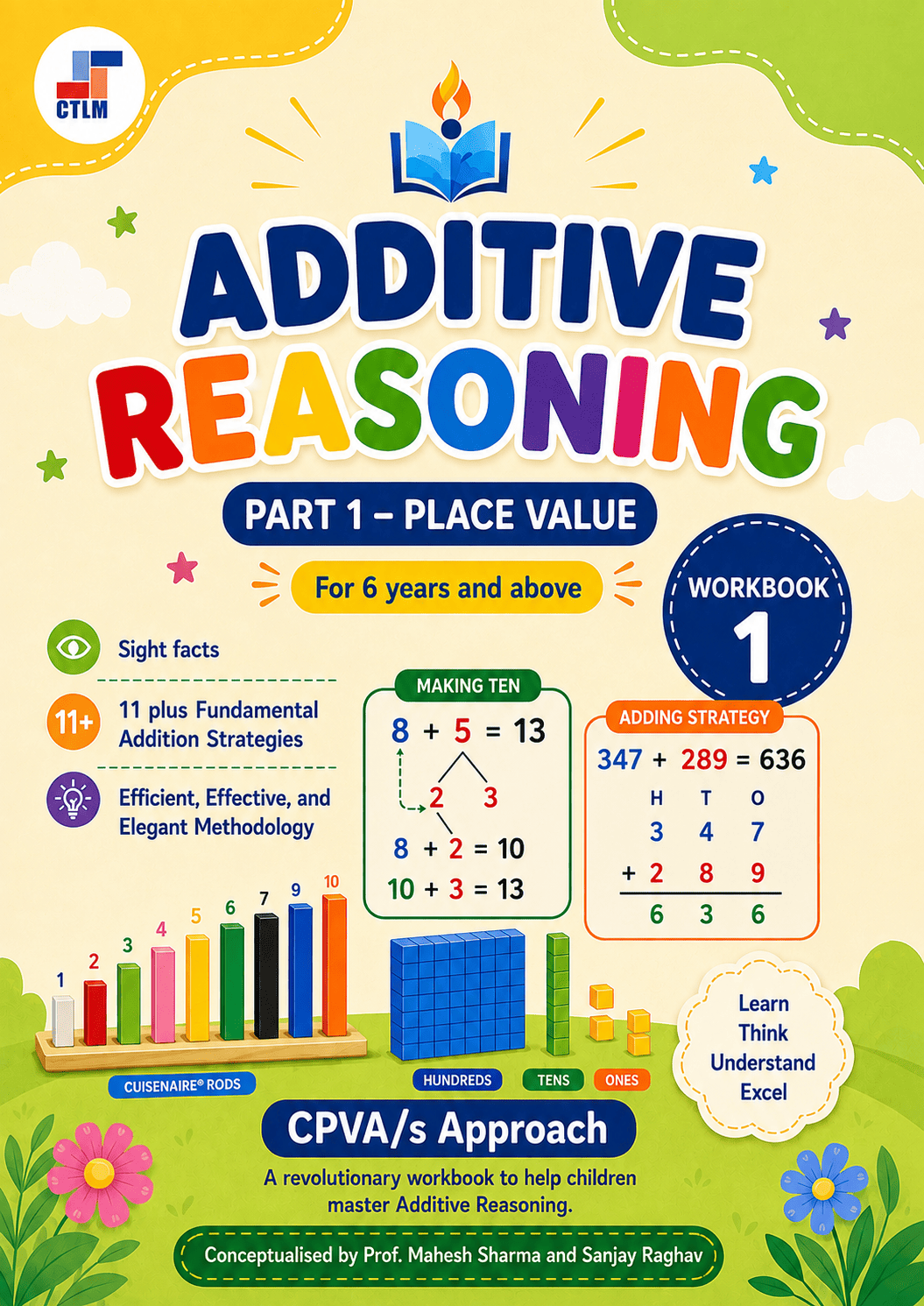
Additive Reasoning Part I: Place value.
Additive Reasoning – Part I: Place Value marks a fundamental shift in a child’s mathematical journey—from understanding number concepts with single-digit numbers to making sense of multi-digit numbers. This transition is critical because children must learn that a digit is a symbol, while its value depends on its position within a number. Based on Professor Mahesh Sharma’s CPVA/s methodology, the workbook develops place value in a carefully structured, child-centric manner. Through concrete experiences, visual representations, mathematical language, and progressively abstract thinking, children learn to clearly distinguish between digits, numbers, and the values represented by digits in different places. Rather than teaching place value as a set of rules to memorise, the workbook helps children construct accurate conceptual schemas for how our base-ten number system works. This strong conceptual foundation prepares them to understand multi-digit numbers flexibly and meaningfully, creating the essential bridge from number concept to additive reasoning and higher arithmetic.
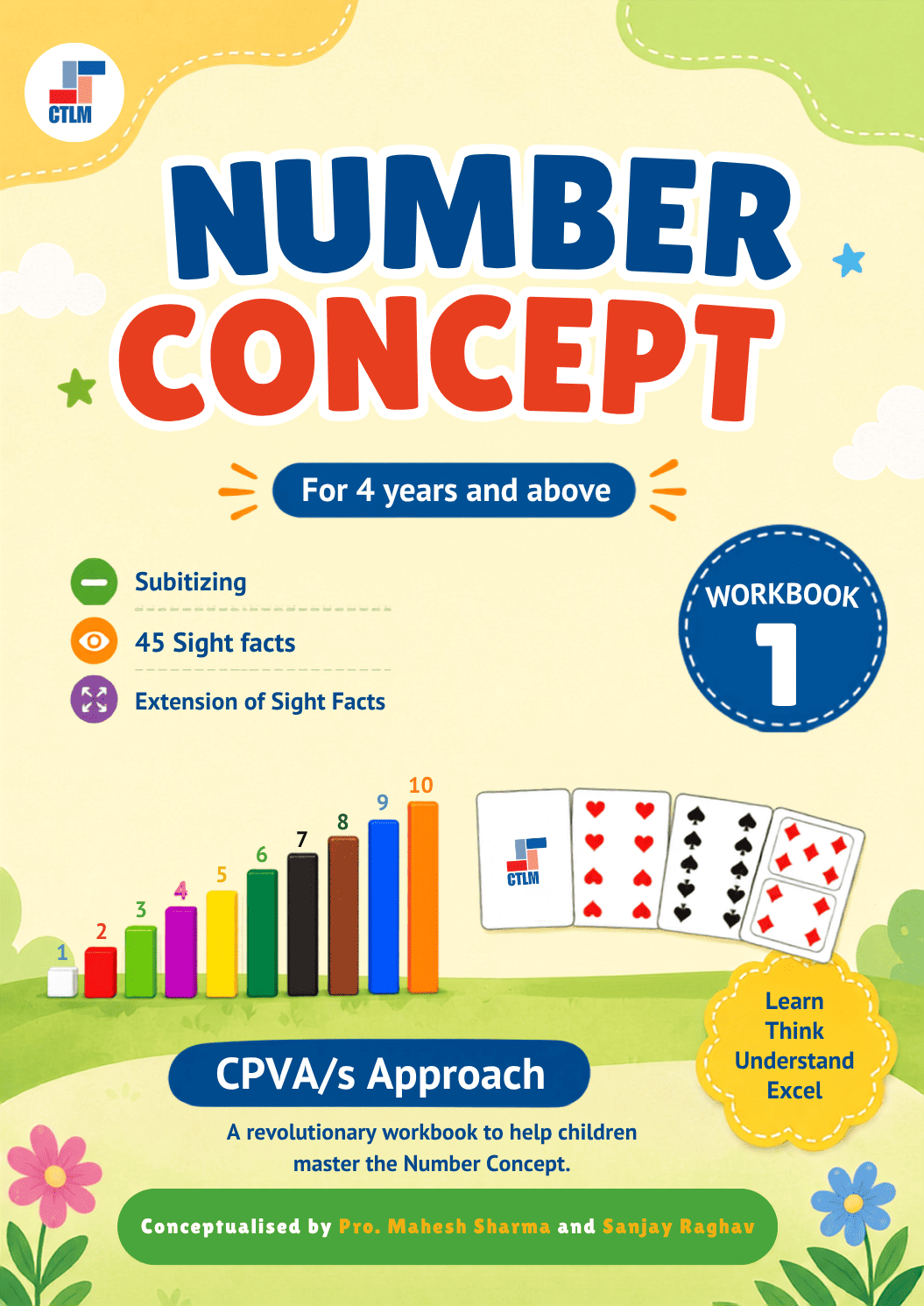
Number Concept Part I
The Number Concept Workbook is designed to take children beyond counting and help them develop a deep, flexible understanding of numbers. Grounded in subitizing, sight facts, and visual clustering, the workbook enables children to recognise quantities, see meaningful patterns, and build fundamental number relationships rather than relying on counting one-by-one. At its core is our trademark CPVA/s methodology, which systematically develops number understanding through concrete experiences, pictorial and visual representations, abstract thinking, and strategic reasoning. Through carefully sequenced activities, children learn to see numbers as relationships—how numbers can be composed, decomposed, compared, and connected. The result is a strong foundation in number sense and number concept, preparing children for confident, efficient, and meaningful mathematical reasoning as they progress to addition, subtraction, and more advanced mathematics.
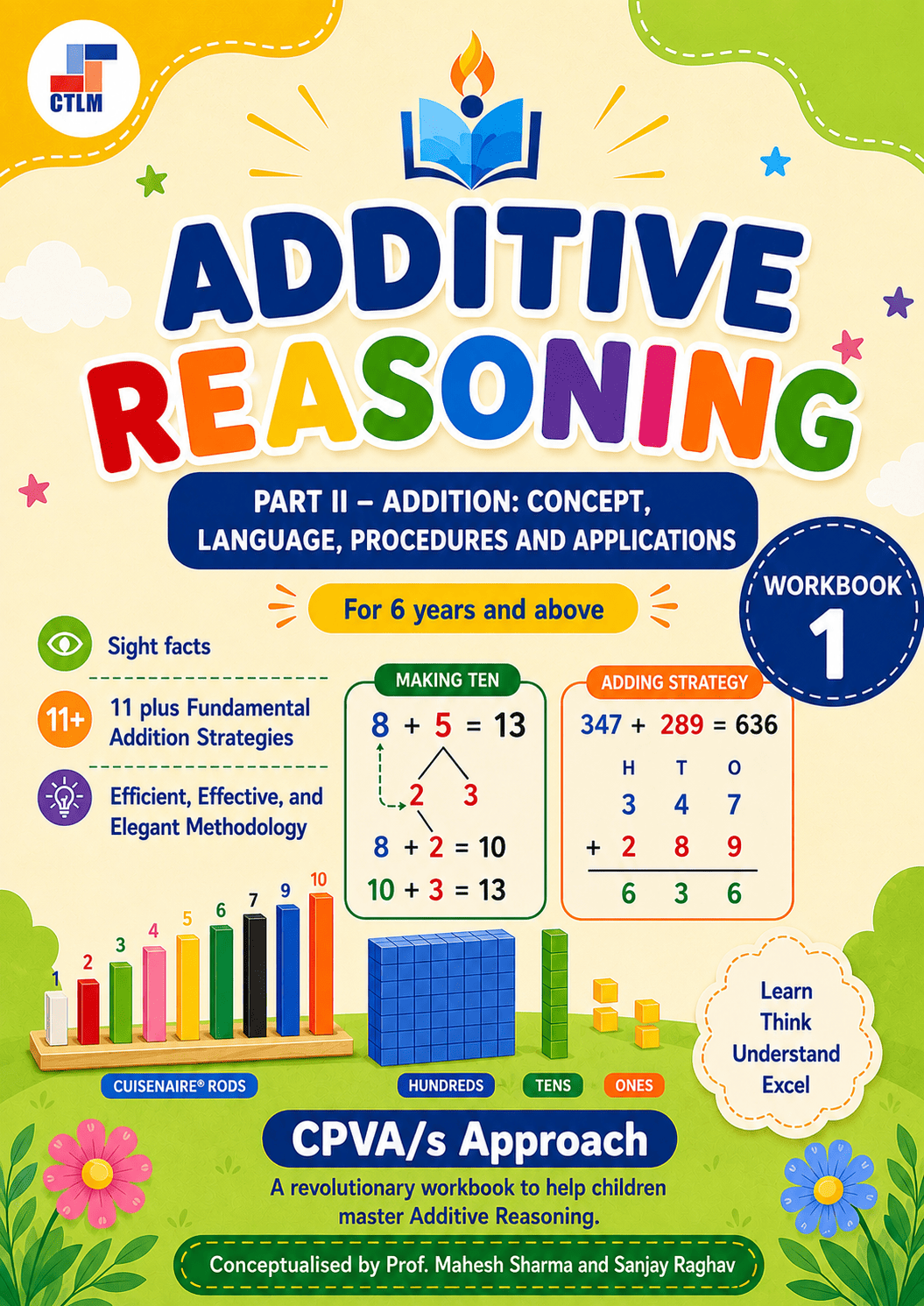
Additive Reasoning Part II: Addition: language, concepts, procedures and applications.
Additive Reasoning – Part II: Addition moves children beyond simply getting the answer to developing a comprehensive
understanding of what addition means, how it is expressed, and how numbers relate to one another. The workbook builds precise mathematical language and strong conceptual schemas, providing children with the foundation to master the 100 basic addition facts with understanding rather than rote memorisation.
At its core are 11+ fundamental addition strategies, carefully developed around the structure of numbers, number relationships, and place value. Children learn to recognise patterns, compose and decompose numbers, make useful number relationships, and select efficient, effective, and elegant strategies for computation.
Structured through Professor Mahesh Sharma’s CPVA/s framework, learning progresses systematically from meaningful concrete experiences and visual representations to mathematical language, abstract reasoning, and strategic application. This enables children to develop not only computational fluency, but also an understanding of the relationships and patterns underlying addition.
The result is a child who can think with numbers rather than merely calculate with them—building the flexibility, confidence, and mathematical reasoning needed for multi-digit computation and increasingly sophisticated mathematics.
Additive Reasoning Part II: Addition: language, concepts, procedures and applications.
Additive Reasoning – Part II: Addition moves children beyond simply getting the answer to developing a comprehensive
understanding of what addition means, how it is expressed, and how numbers relate to one another. The workbook builds precise mathematical language and strong conceptual schemas, providing children with the foundation to master the 100 basic addition facts with understanding rather than rote memorisation.
At its core are 11+ fundamental addition strategies, carefully developed around the structure of numbers, number relationships, and place value. Children learn to recognise patterns, compose and decompose numbers, make useful number relationships, and select efficient, effective, and elegant strategies for computation.
Structured through Professor Mahesh Sharma’s CPVA/s framework, learning progresses systematically from meaningful concrete experiences and visual representations to mathematical language, abstract reasoning, and strategic application. This enables children to develop not only computational fluency, but also an understanding of the relationships and patterns underlying addition.
The result is a child who can think with numbers rather than merely calculate with them—building the flexibility, confidence, and mathematical reasoning needed for multi-digit computation and increasingly sophisticated mathematics.